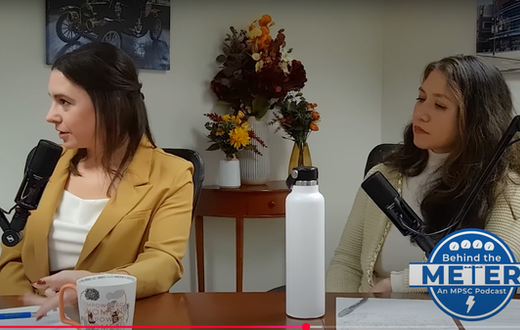
This month's episode on the rate-case process was hosted by Mark Burn, the commission's chief operating officer, and featured all three MPSC commissioners: Chair Dan Scripps, Katherine Peretick, and the most recently appointed Alessandra Carreon.
Burn started with the question, 'What is a rate case?' Chair Scripps answered: 'The bread and butter of what we do here. They're the cases that typically get the most attention, because they directly affect both people's pocketbooks and, ultimately, the resources available to utilities to invest in the infrastructure we all rely on.' He broke down the fundamentals: first, the utility determines how much it believes it needs to invest in the system, including operations and maintenance. Second, it estimates how much it's likely to receive from customers at current rates. Third, if there's a gap — 'if the amount needed for investment in operations and maintenance outstrips the amount it's going to get under current rates, then it can submit to the commission a proposal to increase those rates.'

Commissioner Carreon adds, 'The cost must be reasonable and prudent, and utilities must have the opportunity to earn a fair profit. That necessarily requires that we consider the utility and the shareholders — but ultimately our role is also to ensure we're considering the customer throughout every step of the rate case.' The legislature has determined that the MPSC has no more than ten months to conduct a rate case, including review of the initial proposal and all parties' positions before issuing an order.
We Want Green Too has been an active party in these cases for several years. Before that, resident ratepayers — especially Detroit residents on the city's East Side — had no voice on the record for the MPSC to consider. WWGT's role as a nonprofit intervenor is unique among the parties, which include municipalities like the City of Ann Arbor and large corporations like Kroger or Walmart.
The commission's staff also submit their opinion as part of a rate case's filings, and even the state's Attorney General, Dana Nessel, participates. 'The number and variety of parties is increasing,' Commissioner Peretick adds. 'We're seeing more and more people interested in these rate cases and putting their positions on the record so we can consider them.' This raises a critical point: positions must be added to the record for the commission to weigh them in its final decision on whether — and how much — to raise rates.
In 2009 there were twenty parties submitting filings in DTE's rate case; that number has more than tripled, with sixty-nine participating parties just last year. The types of parties have changed too — more businesses, especially electric companies specializing in EV products, are participating as DTE's proposed increases threaten their margins. During the early 2000s, the City of Detroit was much more involved; unfortunately, that's not the case today.
We Want Green Too has a unique perspective as a Detroit-based organization able to involve residents — particularly on the East Side — by recruiting people from marginalized communities, like fixed-income seniors or low-income Black homeowners, and preparing them to file testimony for the MPSC to review. These are communities whose perspectives have been historically neglected by the state, especially in rate-making. Once all testimonies are filed — from municipalities to businesses, large corporations, and marginalized ratepayers with WWGT's help — the commissioners read and review the hundreds of pages of case filings.
Peretick explains: 'We do dozens of hours of formal deliberations, the three of us talking through each issue, with advice from our advisors, staff, and attorneys. We read the transcripts on the record, sift through the tables of data, and read the justifications both for and against each issue — and there are a lot of issues.' The most recent rate case, she shares, had 318 different issues to decide. Each decision is written into an order issued at a public commission meeting, where each commissioner votes on whether to approve it, making it legally binding — all within ten months.
If the MPSC fails to issue a decision within its ten-month window, the utility gets the increase it proposed, as filed.
'So there's a really significant driver to get all of that work done,' Scripps adds. While more parties make the work more complex, he says it's beneficial: 'The more parties involved, the more complex the record is — but also the richer the record is.' He points to the Utility Consumer Participation Board (UCPB) and the fund it administers to disburse grants to organizations representing residential customers — diversifying the parties beyond the large industrial customers who dominated twenty years ago, when residential issues were neglected. 'Having those voices formally represented gives us a deeper sense of the issues involved, and ultimately a better, more thorough set of evidence to base our decisions on.'
As the public becomes more aware of the MPSC's work, it's critical to understand the difference between the formal process WWGT participates in as an intervenor and the informal processes of posting a public comment or attending a commissioner town hall. 'For the proceeding itself, everything we decide is based on the evidentiary record,' Carreon emphasizes. 'It's what the witnesses filed in their testimony that we ultimately use to decide those 300-plus decision-making points.'
While engaging with the commission in various ways is valuable, it's essential that residents align their expectations with their engagement — understanding that public comments aren't reviewed as part of the evidentiary record in rate cases. Public participation has grown significantly over the last decade, especially as the commission expands its meetings beyond Lansing, with town halls from Detroit to Flint and Grand Rapids. But improving participation should center on closing gaps in understanding around its processes — and on accountability measures that build trust between the public and the MPSC.