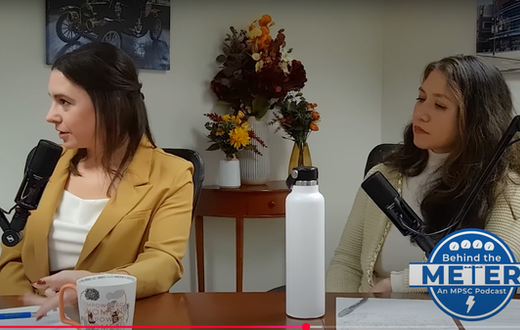
This month's episode, Understanding the Utilities We Regulate, hosted by Mark Burn, features Commissioner Alessandra Carreon alongside the MPSC's longest-tenured employee, Paul Proudfoot, Director of the Commission's Energy Resource Division. Proudfoot recalls starting at the commission in October of 1974: 'The commission up until then had never really raised rates. The economies of scale in the coal-fire industry had allowed them to continually lower rates, but both big utilities were in nuclear programs and struggling to finance the build on the nuclear plants, so they needed to raise rates — and I was hired as a data systems analyst.' An MSU graduate, Paul came on to computerize the rate-case process, which 'at that time meant mainframes and punch cards.'
Commissioner Carreon shares more about what the MPSC regulates today: electricity and natural-gas rates, conditions of service, petroleum-pipeline siting and renewable-energy facility siting, fees and the rulemaking behind them, and certain elements of telecommunications.

Paul reflects on the contrast with when he started: 'There was no EWR — energy waste reduction. There was no integrated resource planning. There were no renewables. There were no capacity demonstration requirements. There was no MISO. There was no regional transmission authority — the utilities owned the transmission.' Alongside computerization, he also spent time in the telephone division when the commission regulated telecom rates more than twenty years ago. He credits the struggles of the nuclear industry with the development of IRPs.
Mark notes how the commission's work substitutes for competition among the public utilities, which operate as monopolies in the state, to avoid monopoly pricing and its negative effects on customers. Carreon highlights the MPSC as a 'creature of statute,' and Paul describes Act 3 (1939) and PA 295 as their major statutes — Act 3 originally being, interestingly, 'the statute to abolish the Public Utilities Commission,' a point Proudfoot encourages staff to remember as legislators continue to build onto it.
The state legislature sets the policies the MPSC implements, and Mark points out that many have been responses to technological innovation — much of it resulting in more regulation for gas and electric companies, in contrast to the deregulation of telecommunications as landlines declined and competitors grew. Paul also spoke to technology's potential to bypass infrastructure investment: 'It was cheaper to just retire a brand-new mechanical exchange and put in a Northern Telecom computer to manage the system than it was to pay the maintenance.' At the time, the commission provided write-offs for new equipment to support that transition. Today, with the push for electrification, EV adoption, and electric services like cold-weather heat pumps, Paul stresses the need for a stronger electric distribution system — which will require increased investment and, as a result, increased rates.
The intergenerational nature of the commission's work is strongly reflected in this discussion between its longest-tenured employee and its most recently appointed commissioner. The commission's decisions — with the support of staff — must take both historic and predictive measures into account, impacting generations beyond any commissioner's appointment. Without the longstanding historical context of staff like Proudfoot, the commission's mission would be impossible.
Commissioners come and go, but Paul Proudfoot lasts forever.