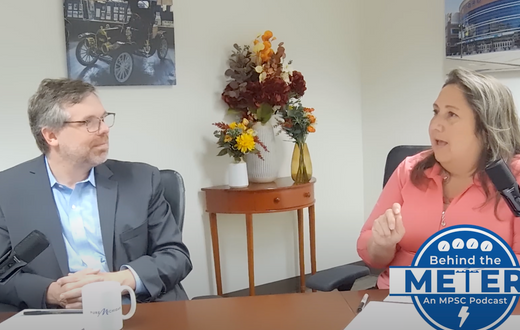
This month's Behind the Meter episode of the MPSC podcast focused on introducing listeners to the MPSC's newest commissioner: Detroit native and former Michigan legislative leadership staffer Shaquila Myers.
Prior to Myers' appointment, community members were gifted with former Commissioner Alessandra Carreon following the voluntary resignation of Commissioner Tremaine L. Phillips. Carreon's term became one of the shortest served on the Michigan Public Service Commission in years. As the first Asian American commissioner in Michigan's history, advocates were hopeful — not only for her aligned perspective on the commission, but for the improvements in public-engagement events and the equity objectives expressed across its communications. When Carreon's departure was announced in June, advocates feared the loss of her influence and the consequences for environmental-justice communities just starting to see themselves heard in the regulatory space.

Residents were reminded of the threat to that progress when Myers consistently abstained from every voting matter during the MPSC's August 7th meeting. While not necessarily unusual for a new commissioner, it left residents with little choice but to be skeptical about the newest member.
This month's episode gave us our first chance to hear what Myers hopes to bring — through her appointment — to those she describes as 'the least of us.' The discussion began with an overview of her previous roles: chief of staff to House Speaker Tate, chief of staff to Lieutenant Governor Gilchrist, and senior advisor to Governor Whitmer. Myers played an instrumental role in the passage of 2023's energy package while in Speaker Tate's office. In Lt. Gov. Gilchrist's office she became intimately involved in expanding access to broadband and telecoms, explaining her reasoning: 'Every part of our life now involves access to the internet, and if you don't have access then that reduces your chances of equity or success… it cuts you off.' Similar phrasing could describe energy itself — it powers broadband and telecoms and, more significantly, the lights, refrigeration, heating, and cooling so often shut off by utilities in underserved homes. As Whitmer's senior advisor, she helped embed equity and environmental justice into the 2023 energy package, and shared her excitement at implementing the clean-energy standard, broadband access, and reliability efforts in Detroit.
Thinking about the least of us — and how we can make their lives better. — Commissioner Shaquila Myers
Though Myers isn't a sustainability, environmental-justice, or clean-energy leader like her Whitmer-appointed predecessors, she brings a wealth of experience collaborating across stakeholders to deliver just solutions for marginalized communities. She helped bring broadband internet to Michiganders through the creation of Michigan's High-Speed Internet Office (MIHI) and the State Digital Equity Capacity Grant Program — an equity-driven accessibility effort that could carry through to energy. Her role in developing 2023's clean-energy package, which set the 100% clean-energy standard, also makes her an authoritative voice on access and implementation across the energy sector, including renewables.
As Commissioner Peretick inquired about 'continuing our work on incorporating public input' and asked 'how to communicate better' — both areas previously headed by Carreon — Myers' response focused on equitable outcomes and the need to report back to impacted communities on the deliverables achieved in response to their concerns. There were three main takeaways from her first podcast appearance. First, Myers has demonstrated adaptability under tight deadlines that could serve conflicting interests between advocates and utilities. Second, as a policymaker her interpretation of policy is adept — especially in the areas of the energy package that so much of our EJ work relies on. Finally, she outlined clear objectives that ratepayers can hold her accountable to: providing access and reliability while centering the least of us — Black, low-to-middle income, fixed income, seniors, the medically vulnerable, under-serviced, and otherwise marginalized populations.
Whether or not we have trust in Michigan's regulatory process, we must do our part to ensure these objectives are carried through the entirety of Myers' term. If, by the end of it, the goals she's expressed are sufficiently integrated, ratepayers will be able to lean into a ratemaking process that serves their interests — balanced against utilities that have historically been catered to, decade after decade. Shifting the scales requires intentionality, and I believe Myers has the makings to build upon the work Carreon began by pivoting the commission toward equity and engagement.